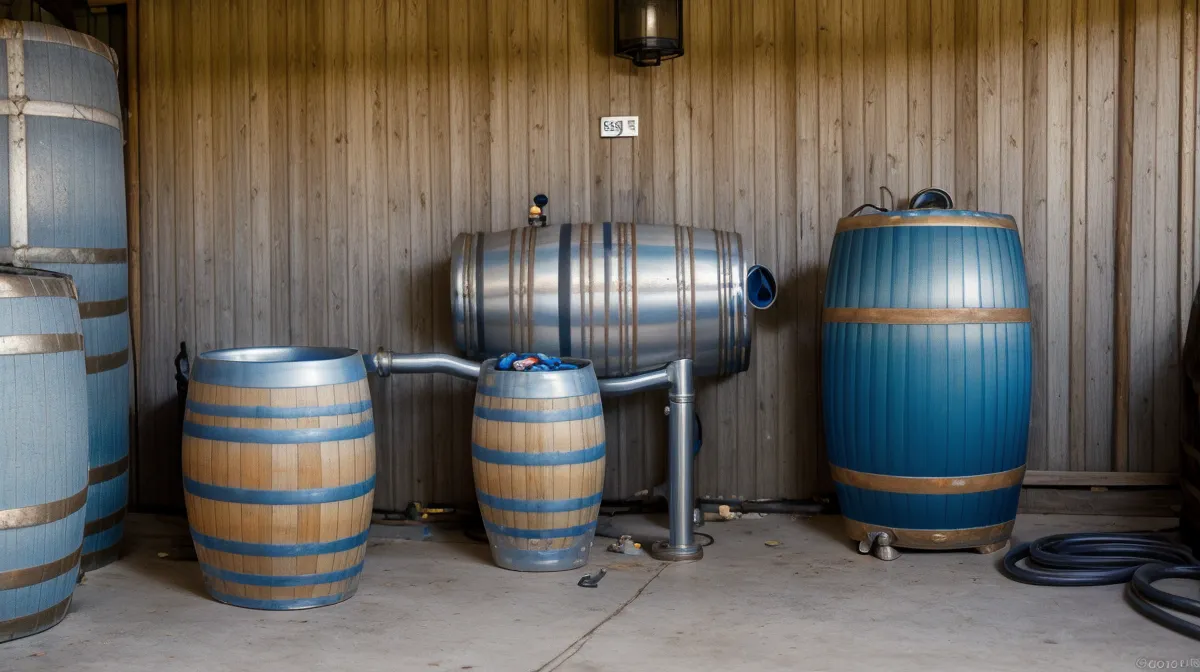
I was standing in my garage late last October, staring at a giant blue plastic monolith that had occupied a corner of my workspace for over a year. It was a humid evening—the kind where the Houston air feels like a damp wool blanket—and I realized that the 55 gallons of emergency water I’d meticulously stored after Hurricane Beryl was now essentially a 450-pound paperweight of unknown quality. In the IT world, we call this stale data. In the world of suburban preparedness, it’s just a potential breeding ground for things you don’t want to drink. I knew it was time for a rotation, but I quickly realized I had no plan for how to move that much liquid without turning my garage into an indoor swimming pool.
The Troubleshooting Logic of the 55-Gallon Drum
When you work in IT support, your first instinct is to look at the hardware specs. A standard blue drum capacity is 55 gallons. That sounds manageable until you do the math. The weight of water per gallon is approximately 8.34 pounds. Multiply that out, and you’re looking at over 458 pounds of dead weight sitting on a wooden pallet. It’s not like a server rack; there are no wheels, no cable management, and no easy way to 'reboot' the system if things go sideways. My spouse had already given me that look—the one that says, "I told you this thing was a bit much"—so I knew I had to execute this rotation with the precision of a midnight firmware update.
The problem with large-scale water storage isn't the storage itself; it’s the maintenance. We often treat these barrels like a 'set it and forget it' backup drive, but water is a living thing. If it sits too long, it gets flat, it can pick up plastic tastes, or worse, it can grow things if your initial seal wasn't perfect. I decided to treat the rotation like a data migration. I needed to drain the old 'data,' sanitize the 'drive,' and upload a fresh, clean batch. But unlike a digital migration, this one involved a garden hose, a cheap plastic pump, and a lot of physics.

Gravity is a Harsher Taskmaster than a Server Rack
During a humid week in July, I finally committed to the task. My plan was simple: use a siphon to drain the barrel out the side garage door and into the driveway. If you’ve ever tried to troubleshoot a router remotely with a bad connection, you know the frustration of 'almost' getting a signal. That was me with the siphon. I was using a basic hand-pump kit I’d found at a local hardware store, and for the first twenty minutes, all I got was a workout and a few pathetic dribbles.
The cold splash of water on my shins when the siphon finally caught, smelling faintly of a public swimming pool, was the first sign of success. It was a refreshing shock against the July humidity, even if it meant I was now committed to the next hour of drainage. I watched the water flow and realized that I had effectively tethered myself to this barrel. You can't just walk away from a draining 55-gallon drum in a finished garage. If that hose slips, you aren't just losing water; you’re ruining drywall. I spent the time thinking about the garage water rotation routine I’d need to develop to make this less of a chore next time.
As the water level dropped, I had to wrestle with the physical reality of the container. The dull ache in my lower back after wrestling the empty plastic drum two inches to the left to clear the pallet edge reminded me that I’m more used to lifting laptops than industrial containers. These drums are made of high-density polyethylene (HDPE), which is the industry standard for BPA-free long-term water storage, but they aren't designed for easy handling. Once it was empty, I realized the 'bottom of the barrel' isn't just a metaphor—there was a fine layer of sediment that I had to rinse out manually, which felt a lot like cleaning out a dusty old PC case with compressed air.
The Chlorine Calculation and the Flower Bed Incident
Refilling the barrel is the easy part; it’s the treatment that requires a steady hand. I’m not a doctor or a water treatment specialist—I have zero medical training—so I strictly follow the CDC bleach disinfection ratio. For clear water, the standard is 8 drops per gallon of unscented, non-color-safe household bleach (the kind that is 6% to 8.25% strength). For a 55-gallon drum, that’s about 440 drops, which is roughly 4.5 teaspoons. It sounds like a tiny amount for such a massive volume of water, but chemistry doesn't care about your intuition. You should always consult your professional local water reports or a specialist if you're unsure about your local tap quality before committing to long-term storage.

One Saturday morning last month, as I was finishing the refill, I had my first 'system failure.' I had been directing the overflow of the rinse water toward the side of the house. I hadn't considered that my spouse’s favorite flower beds were right in the path of the slightly chlorinated drainage. In my focus on the 'hardware' (the barrel), I’d ignored the 'environment' (the garden). Luckily, the dilution was high enough that most of the plants survived, but the lecture I received was a potent reminder that emergency prep doesn't happen in a vacuum. It has to coexist with the people you live with.
This experience led me to a bit of a mid-prep crisis. While the 55-gallon drum is the gold standard for 'prepper' aesthetics, it’s a massive liability for a regular suburban family. If I have to move that water in an emergency because of a foundation issue or a localized flood, I can't. It’s locked in place. I started looking into how I could diversify my 'portfolio' of water. I’ve been field testing four modern water backup solutions that offer a bit more flexibility than the big blue drum, and honestly, they fit my IT mindset much better—modular, redundant, and easier to 'hot-swap' when needed.
The Shift to Point-of-Use Resilience
After a year of testing every gadget that hit my search results, my perspective has shifted. Storing 55 gallons is great for a 'total system failure' scenario, but for the 95% of outages we actually face in Houston, it might be overkill. I’ve realized that focusing on point-of-use filtration for the infrastructure I already have—like the water sitting in my water heater or the pool—is often more practical than maintaining a fleet of heavy barrels. It’s the difference between having a massive server on-site versus using a flexible cloud service. Both have their place, but one is a lot easier to manage on a Saturday morning.
I finally finished the refill and marked the date on the side of the drum with a fresh Sharpie. There’s a certain satisfaction in that—the same feeling you get when you close all your support tickets at the end of a long Friday. My family is covered for at least a few days if the taps go dry again, and I’ve documented the 'process' so the next rotation won't involve a backache or a garden catastrophe. If you're starting your own storage journey, my advice is to start small. Don't jump straight to the 55-gallon dream unless you're prepared to handle the 450-pound reality that comes with it. Troubleshooting your water supply is just like troubleshooting a network: start with the simplest point of failure and work your way up.
At the end of the day, I’m just a guy in the suburbs trying to make sure his kids can brush their teeth when the power goes out. It’s not about being a survivalist; it’s about being a responsible 'system admin' for your home. Just make sure you keep the bleach away from the petunias.