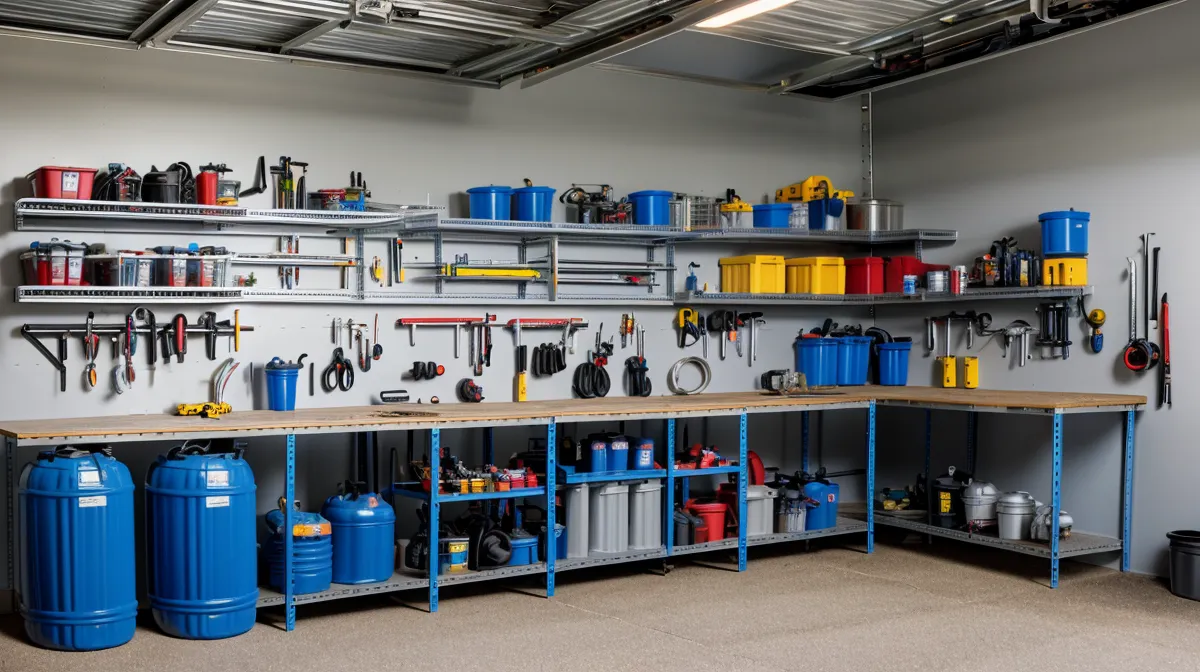
A cracked seam on a water jug doesn't announce itself. It weeps, a slow dark stain spreading across the concrete floor of my garage, long before the footer-a116d1 is anywhere close to empty. That's how I learned that stackable plastic jugs, the kind marketed as a space-saving alternative to a barrel, don't survive a full Texas summer against a block wall. The jugs looked fine stacked. They were not fine underneath, and that gap between looking fine and actually working is most of what emergency water purification comes down to.
I got serious about water purification the way a lot of people west of Houston did — after Hurricane Beryl cut the tap for four days and left me with a case of bottled water and not much of a real plan. What started as a couple of test buckets on a folding table turned into an actual setup: a pegboard of hose fittings and hand pumps on one wall, rows of labeled containers stacked along another, a utility sink I use only for fill-and-flush testing. None of that gear matters, though, if you don't understand the one distinction that trips up almost everyone doing emergency preparedness for the first time. If you haven't sorted out containers yet, that's the physical layer worth fixing before anything else — the 5 best emergency water storage containers for small suburban garages is a reasonable place to start.
Water Purification and Filtration Solve Two Different Problems
Purification and filtration get treated like synonyms, and that mix-up is where most plans fall apart. Purification kills or neutralizes what's biologically dangerous — bacteria, viruses, parasites — through heat or chemical treatment. Filtration is a physical barrier that removes what's suspended or dissolved in the water, whether that's sediment, cysts, or in some cases heavy metals, depending on what the filter media is built to catch. A purifier can leave you with water that's biologically safe and still gritty. A filter can leave you with water that looks clean and still carries something that will make you sick. They're stacked requirements, not competing options — closer to a firewall sitting in front of a server than two versions of the same tool.
A colleague of mine, Tiffany Bui, is who actually pushed me to sort this out properly. She caught me in the break room after flooding damaged her parents' place and asked whether her camping filter alone would cover everything — a fair question, and one I realized I couldn't answer with real confidence. That's an uncomfortable thing to notice after months of testing gear in a garage. It's also exactly why purification and filtration now live as two separate columns on my testing notes instead of one blurry category.
Which Wins for a Multi-Day Outage — Boiling or Chemical Treatment?
Boiling is the most reliable purification method available, and it isn't close. Bring water to a rolling boil for a full minute — three minutes above 6,500 feet, which nobody around Houston needs to worry about — and it kills the bacteria, viruses, and parasites that actually make people sick. What it does nothing for is chemical contamination. Heavy metals and other chemical residue pass straight through a boil untouched, so boiling solves exactly half the problem and ignores the other half completely. Boiling water is the gold standard for biological safety and a non-answer for anything else.
Scale is where boiling falls apart. One pot is no trouble. A household's entire supply for a multi-day outage is a fuel problem — the baseline math of a gallon per person per day adds up fast once you're planning past the first twenty-four hours — and every pot you boil for drinking is fuel you don't have for cooking or for keeping the house tolerable with the power out and the windows shut.
Chemical treatment scales better because it doesn't cost fuel, but it brings its own failure points. Liquid bleach has a shelf life, and treating an old bottle as if it's still at full strength will throw off your dosing math, sometimes badly. Anyone who wants something with a longer, more predictable shelf life than a bottle that's been sitting under the sink since the last storm should look at the best emergency water purification drops for long term potable storage instead. Dosing chemical treatment for a garage full of stored containers is also just tedious — nobody enjoys standing over water with a dropper — but it's the only purification method here that doesn't need a heat source, which matters when the power's out and you're rationing propane.
So which one wins? Boiling wins when you need water safe within minutes and you've still got fuel to spare — a day or two into an outage, one pot at a time. Chemical treatment wins once you're purifying in bulk for longer than that, because it scales without burning through propane or camp fuel. Run both in a real outage and each one covers the other's weak spot.
Sizing Up Physical Filtration: Pre-Filters, Ceramic Elements, and Gravity Systems
Local water pressure drops during an outage and kicks up sediment that's been sitting in the pipes for years — sediment that will wreck an expensive filter cartridge in minutes if it runs through unfiltered. My workaround is embarrassingly low-tech: a clean bucket, a t-shirt or a stack of coffee filters stretched over the top, water poured through before it ever touches anything carrying an NSF/ANSI rating for lead or cysts. Think of it like clearing the bulk mess out of a closet before you try to organize what's left on the shelves — deal with the big stuff first so the fine sorting actually works.
Gravity filters are the better option for producing real volume over days instead of minutes, though exactly how fast one processes water is its own conversation, and it's not the same across every unit — that tradeoff between speed and convenience is worth researching before you buy, not during an outage. The best gravity water filters for families during a long power outage are built with that volume problem in mind, but none of them replace the pre-filter step.
A reader named Darnell Fontenot has been emailing me questions since he found the site, and he's refreshingly blunt about what he can and can't justify. His question, more or less, was whether he needed the expensive rated filter or could get away with the cheap workaround. The honest answer is that the pre-filter step protects whatever filter you already own, expensive or not — it isn't a substitute for a rated filter, it's what keeps that filter working once the water turns ugly.
What Redundancy Actually Costs You in Time and Fuel
This is suburban survival math, not bunker prepping — arithmetic anyone can run, not a lifestyle. How you purify only matters as much as how you store what you've purified. Figuring out how much storage capacity a household actually needs is its own planning exercise, and it shifts depending on whether you're set up around bulk containers or a rack of smaller ones. Bulk is efficient until you have to move it: shift a full drum by hand and you'll feel the water sway sideways in a slow wave before the drum itself even seems to budge, which is not a sensation you want to discover mid-emergency. Smaller portable containers trade that bulk efficiency for something you can actually carry to a car if you have to evacuate, which is a different emergency than the one where you're sheltering in place. Whatever you land on, water sitting in storage for months needs a rotation schedule and a real container-cleaning routine, or purification stops mattering because the footer-a116d1 becomes the contamination source.
Packing for a road trip is a decent way to think about what each method actually costs. Nobody brings one bag for a two-week trip and calls it done — you bring what covers the likely scenarios and accept that some of it won't get used. Boiling costs fuel and time per gallon. Chemical treatment costs shelf-life management and a taste most people don't love. Filtration costs money up front and a pre-filter step you can't skip. None of them are free, and treating any single method as if it covers everything is how a supposedly redundant system ends up with one point of failure.
Building a System That Doesn't Depend on One Method Working
A system that doesn't depend on any one method holding up means running purification and filtration side by side instead of picking a favorite and hoping it's enough. If the bleach is past its window or a ceramic element cracks, a second method should already be in place — not something you're scrambling to source once the tap goes quiet. I noticed this again testing a stored tank a while back: dipped a test strip in, and the color landed right in the safe zone on the first try, which only happens when the storage and the purification behind it were both handled correctly, not by luck.
If you only remember one thing, remember this: purification tells you the water won't make you sick, filtration tells you it's actually drinkable, and a real plan needs both columns filled in — not just the one that seemed easier at the store.