Four days without tap water after Hurricane Beryl knocked out our neighborhood in 2024 taught me that "I'll just boil it" is not a plan — it's a hope. Since then I've run basically every method on this page through my garage: camp-stove boils, a UV pen that died on me mid-batch, a ceramic filter that clogged solid after one afternoon of muddy runoff (that one's on me — I never should have run it straight off a drainage ditch without a pre-filter). This page is the technical backbone of all that testing — the pore sizes, the contact times, the stuff that actually decides whether a method is doing something or just making you feel better. I pulled every number below straight from EPA, university extension programs, and a couple of peer-reviewed papers, and swapped out anything I couldn't verify myself. No vibes, no marketing copy.
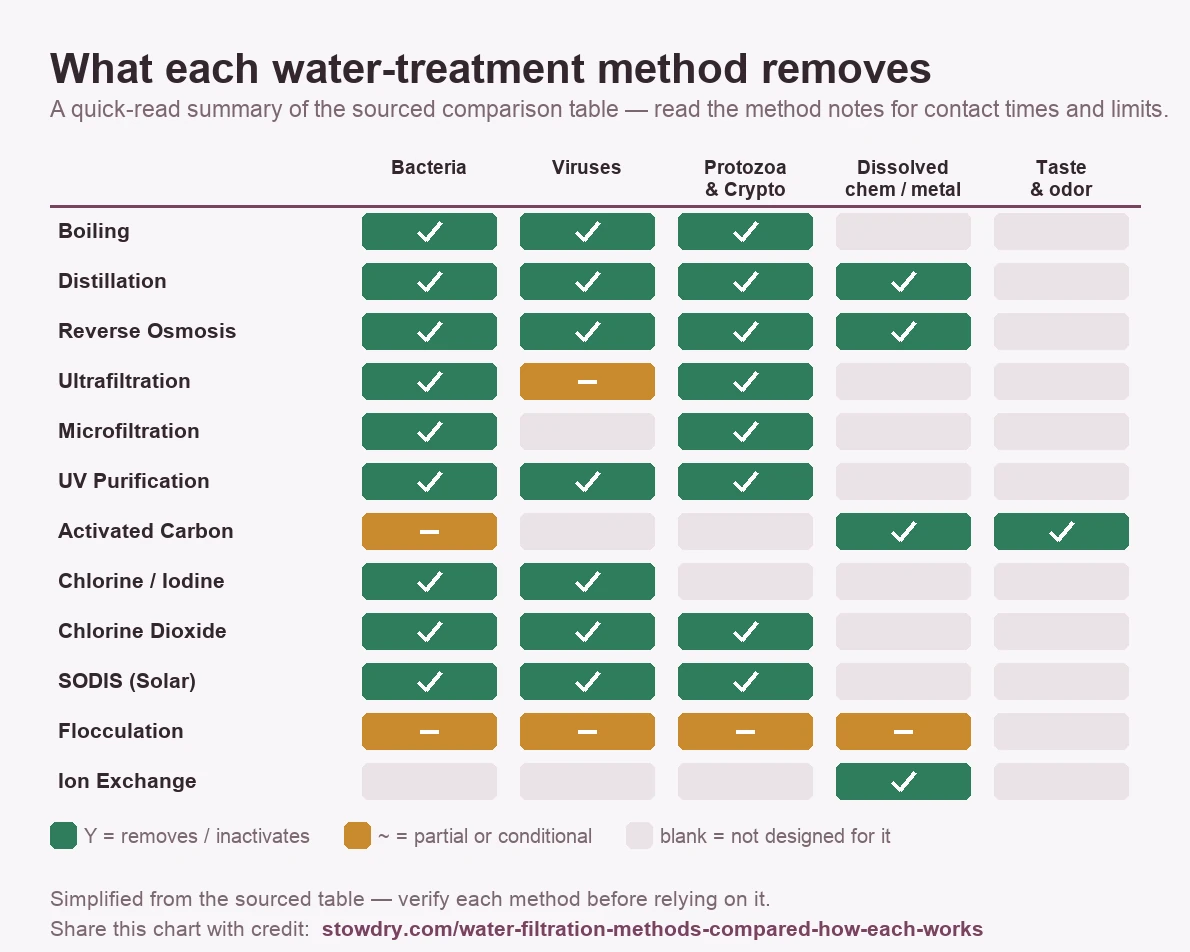
The rule that matters most: if a boil-water notice names Cryptosporidium, iodine and plain chlorine alone won't touch it [1] — you need a sub-micron filter, chlorine dioxide with a full 4-hour contact time [1], distillation, or a rolling boil.
Comparison of Water Treatment Methods
| Method | Mechanism | Pore Size (Microns) | Microbial Targets | Chemical/Mineral Removal |
|---|---|---|---|---|
| Boiling | Thermal Inactivation | N/A | Bacteria, Viruses, Protozoa [1] | None (may concentrate minerals) |
| Distillation | Phase Change | N/A | Bacteria, Viruses, Protozoa [2] | Heavy metals, nitrates, salts (up to 99.5% of impurities) [2] |
| Reverse Osmosis | Semi-permeable Membrane | ~0.0001 [3] | Bacteria, Viruses, Protozoa | Salt, lead, most dissolved minerals [3] |
| Ultrafiltration | Membrane Barrier | ~0.01 [3] | Bacteria, Protozoa, most Viruses [3] | Suspended solids, particulates (not dissolved minerals) |
| Microfiltration | Mechanical Barrier | 0.1 to 0.3 [1] | Bacteria, Protozoa | Sediment, turbidity |
| UV Purification | DNA/RNA Disruption | N/A | Bacteria, Viruses, Protozoa [1] (4-log / 99.99% benchmark for viruses [4]) | None |
| Activated Carbon | Adsorption | 0.5 to 50 (varies) [5] | Limited (unless block-rated sub-micron) | Chlorine, VOCs/THMs, taste/odor [5] |
| Chlorine/Iodine | Oxidation | N/A | Bacteria, Viruses [1] | None (does not inactivate Cryptosporidium cysts) [1] |
| Chlorine Dioxide | Oxidation | N/A | Bacteria, Viruses, Protozoa [1] | None (30 min for most pathogens; 4 hours for Cryptosporidium) [1] |
| SODIS (Solar) | UV-A/UV-B + Thermal | N/A | Bacteria, Viruses, Protozoa [6] | None |
| Flocculation | Coagulation/Sediment | N/A | Partial (via settling) | Heavy metals (partial), turbidity |
| Ion Exchange | Resin Substitution | N/A | None | Hardness (Ca/Mg), PFAS [7] [8] |
Mechanical and Membrane Filtration
- Reverse Osmosis (RO)
- This is the one that turned a corner of our pantry into what my spouse calls "the RO shelf." A pump forces water through a membrane rated around 0.0001 microns [3] — small enough to strip out dissolved salt and lead along with most of the minerals in the water [3]. That's the tradeoff nobody puts on the box: the water comes out so clean it tastes a little flat, like something's missing (because something is). Every RO setup I've run needed a sediment pre-filter ahead of it or the membrane clogs fast — I skipped that step once on a hunch and paid for a new membrane not long after.
- Ultrafiltration (UF)
- Think of UF as RO's less paranoid sibling — same idea, bigger holes. At around 0.01 microns [3] it physically blocks bacteria, protozoa, and most viruses, but it lets dissolved minerals and salt sail right through [3]. Good for gross biological contamination, useless if your actual problem is hard water or nitrates.
- Microfiltration / Ceramic Filters
- This is the workhorse of the portable field filters, and the one my ceramic-clogging story above is about. The practical rated range is an absolute pore size under 0.1 micron to knock out protozoa, and 0.3 micron or smaller to knock out bacteria [1]. What it generally can't touch is viruses — they're small enough to slip through pores rated at that size, which is exactly why backpackers pair a ceramic filter with a chemical or UV step. Cheap insurance, one extra step, worth it.
Chemical and UV Purification
- Ultraviolet (UV) Light
- Short-wavelength UV light scrambles the DNA and RNA of whatever's swimming in your water so it can't reproduce [1]. The catch — and this one bit me — is that it only works on water that's actually clear; the little UV wand I used stirs for about 60 seconds per bottle [1], and mine died halfway through a batch of slightly cloudy creek water because I hadn't pre-filtered it and the sensor kept faulting. The benchmark the industry validates UV reactors against is a 4-log, or 99.99%, inactivation of viruses [4] — but that number assumes clear water and fresh batteries, which is a bigger "if" than the packaging lets on.
- Halogen Disinfection (Chlorine/Iodine)
- Cheap, light, and the tablets that lived in my glovebox for two years before Beryl. Chlorine and iodine both handle bacteria and viruses well, with iodine typically needing around thirty minutes of contact time [1]. What they don't do is touch Cryptosporidium — iodine specifically does not inactivate Cryptosporidium cysts [1], so if your local boil-water notice mentions "Crypto" by name, halogen tablets alone are not the answer. Iodine also isn't recommended if you're pregnant or have a thyroid condition — check with your doctor before you rely on it.
- Chlorine Dioxide
- The upgrade over plain chlorine — it actually improves taste and odor instead of leaving that public-pool aftertaste, and it can inactivate Cryptosporidium when used correctly. The catch is time: about 30 minutes handles most bacteria and viruses, but Cryptosporidium needs a full 4 hours of contact [1]. That's a long wait when you're thirsty, which is why I keep this paired with a filter rather than relying on it solo.
Thermal and Solar Methods
- Boiling
- The one everybody already knows and the one I still managed to mess up during Beryl — ran a pot without a lid on the camp stove and burned through half a propane canister waiting for a "rolling" boil that kept getting interrupted by wind. For what it's worth: a true rolling boil for at least 60 seconds handles it below 2000 meters (6,562 feet) elevation; above that, give it a full 3 minutes [1]. It's the most reliable method there is against bacteria, viruses, and protozoa — it just costs you fuel and time, and neither is free in an actual emergency.
- SODIS (Solar Water Disinfection)
- The closest thing to free purification you'll find, and also the one I trust least on instinct alone. Fill clear PET bottles with low-turbidity water and leave them in direct sun for at least 6 hours [6] — and I mean direct, not "on the porch under the awning" direct. The disinfection comes from a combination of solar UV-B and UV-A radiation plus plain heat, with the two effects reinforcing each other once the water climbs above 45°C [6]. Houston summers make that part easy; the part I can never verify without a thermometer is whether the water actually got hot enough, which is exactly why I only use this as a last resort, not a first plan.
Adsorption and Ion Exchange
- Activated Carbon (GAC/Block)
- Works by adsorption — contaminants stick to the carbon's enormous internal surface area instead of passing through. Depending on the grade, these filters are rated anywhere from 50 microns down to 0.5 micron [5], and they're genuinely good at pulling chlorine, VOCs and trihalomethanes, and the stuff that makes water taste or smell off [5]. What it won't do is remove minerals, and it won't reliably stop microbes unless it's specifically block-rated sub-micron. I bought a cheap carbon pitcher filter hoping it would fix our well water's sulfur smell after a storm — it took the edge off and that's it, still smelled like a struck match. Wrong tool for that job.
- Ion Exchange
- Resin beads that act like tiny magnets, swapping out unwanted ions for harmless ones [7]. In a standard home softener that means pulling calcium and magnesium (hardness) almost entirely out of the water, plus up to 10 ppm of iron and manganese along the way [8]. A different resin type — anion exchange — is also one of the few technologies that actually pulls PFAS out of drinking water [7]. Neither type does anything for bacteria or viruses, so this is a mineral/chemical tool, not a disinfection one.
Water safety is not a place to guess. Everything above is informational — it's what I've tested and what the sources actually say, not medical or emergency-management advice for your specific situation. If you or your family get sick after drinking treated water, or you're weighing a purification method against a real health condition (pregnancy, a thyroid issue, a compromised immune system), talk to a doctor or your local health department before you bet on any single method. And if a boil-water advisory in your area specifically names Cryptosporidium, don't reach for iodine or plain chlorine alone — neither one touches it.
Last verified: 2026-07-12
Sources
- Colorado State University Extension: Guide to Treating Water in the Backcountry
- University of Nebraska-Lincoln Extension: Drinking Water Treatment: Distillation (G1493)
- Safe Drinking Water Foundation: Ultrafiltration, Nanofiltration and Reverse Osmosis Fact Sheet
- US EPA Science Inventory: Ultraviolet (UV) Disinfection for Drinking Water Systems
- NDSU Extension: Filtration: Sediment, Activated Carbon, and Mixed Media
- PMC: Microbiological Evaluation of Transparent Buckets for Solar Water Disinfection (SODIS)
- US EPA: Reducing PFAS in Drinking Water with Treatment Technologies
- NDSU Extension: Water Softening (Ion Exchange), WQ1031