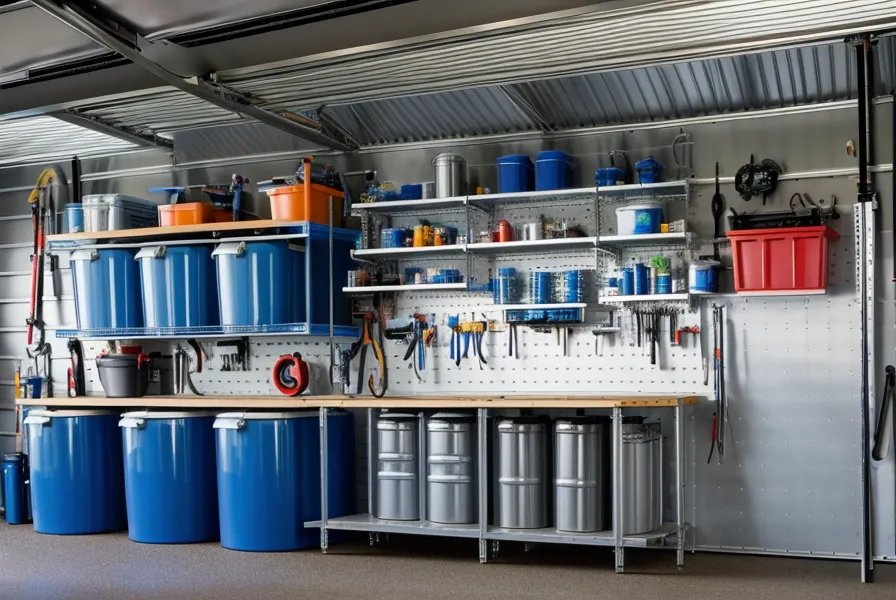
The crank handle jams somewhere around rotation three hundred, and the next half-gallon of stale drum water goes sideways across the concrete instead of into the bucket under the spigot. My shoulder is done. The barrel is maybe a third empty. And this is supposed to be the easy part of rotating emergency water through storage barrels in my garage — the siphon pump, not the hauling, not the refilling, just getting the old water out.
Quick note before the pump comparisons: I make a commission on some of the links below if you click through and buy something, and it costs you nothing extra. Every pump, valve, and fitting mentioned here got bought with my own card and tested in this garage, not borrowed from a manufacturer hoping for a good review.
Four days without municipal water pressure during Hurricane Beryl in 2024 is what started all of this. Before the barrels, I kept a dozen stackable plastic jugs against the same garage wall, and by the end of one Texas summer a few of them had split quietly along the seams — I only found out when I picked one up and water ran down my arm. That's when I switched to food-grade drums, the kind FEMA and the CDC implicitly assume you own when they set the baseline emergency water recommendation at one gallon per person per day.
For a family of four riding out an extended outage, that math adds up fast, and a couple of heavy drums looked like a cheap, obvious answer. One sits at roughly four hundred fifty-eight pounds once full — fifty-five gallons at a little over eight pounds each — and dead weight like that doesn't move unless you pump it out through a two-inch bung opening. Tipping it, dragging it, or lifting it onto a dolly are all off the table once the water's inside.
Rotating that volume isn't optional, either — sealed drums don't stay fresh forever without retreatment, and I've mapped out the actual week-by-week rotation schedule I use in another post, so I won't repeat the whole thing here. If the idea of hauling two four-hundred-pound drums out to a flowerbed every six months already sounds exhausting, it's worth glancing at something like the SmartWaterBox system, which skips bulk drums in favor of a self-contained setup. But if you've already got barrels sitting on your slab, the pump is what actually matters, so let's get into what held up and what didn't.
The 450-Pound Problem With Emergency Water Storage Barrels
Troubleshooting a system that fails under load is basically my day job — I do IT support, and the instinct when something breaks is to look at the physical bottleneck instead of just restarting it and hoping. A coworker named Tiffany Bui asked me about water prep after flooding damaged her parents' place, and when I couldn't give her a straight answer backed by an actual number, that bugged me enough to start testing pumps properly instead of guessing. Tiffany doesn't accept "it's a lot of cranking" as a real answer — she wants the rotation count — so a lot of what follows exists because she pushed for it.
Cheap shake-siphons and squeeze bulbs — the kind bundled free with a lot of barrel kits — rely entirely on gravity to move water, and that only works if your discharge point sits lower than the bottom third of the barrel. Drop the water level below your intake head and the siphon just stalls, no matter how hard you squeeze. On a flat garage slab, there's no natural elevation drop to an outdoor drain or a flowerbed, so you either lift the whole drum onto a riser (lifting four hundred-plus pounds two feet up, which isn't happening solo) or you use a pump that forces the water out instead of coaxing it.
Houston summers are brutal on anything plastic sitting in a closed garage, and a lot of the fittings that ship with bargain pump kits develop hairline cracks after a season or two of that heat — I go deeper into which fittings held up in my rundown on managing bulk water storage in a suburban garage. For this piece, the short version is: check your bung threads before you buy anything. Drums use either fine NPT threads or coarse buttress threads, and forcing the wrong adapter into a buttress bung strips the plastic and lets in enough air to kill your suction instantly.
Which Pump Actually Survives a Houston Garage Summer?
Rotary-crank hand pumps are the bulletproof option — cast aluminum housing, Teflon seals, nothing electronic to fail — and the one I tested threaded straight into a standard two-inch bung without issue. It also took close to four hundred full rotations to empty one fifty-five-gallon drum. By gallon thirty my shirt was soaked and my shoulder had nothing left to give, which is fine if the grid is down and this is the one time you need it, but as a twice-a-year maintenance chore it's closer to a rowing workout than a household task.
Battery-powered transfer wands flip that tradeoff completely. Drop in two D-cell batteries, slide the shaft into the bung, clip the hose to a bucket, and press a button — mine moved close to three gallons a minute without any effort on my part. Then, two weeks later, after sitting in a garage where it regularly hits a hundred and five degrees, the plastic impeller housing had warped just enough that the motor seized under load the next time I needed it. That kind of heat failure is common enough with plastic components that I keep a running list of what cracks or warps in that garage specifically, which lives in a separate post — but the short version for pumps is that convenience and reliability are often fighting each other.
The middle ground was a heavy-duty lever-action piston pump, which turned out to be the one I reach for most now. No batteries to fry, noticeably less arm strain than the crank version, and it never lost prime across a dozen test cycles — the tradeoff is that it's bulkier to store than either of the other two, and the first pump stroke after priming always needs a firm hand before it catches.
None of this matters much if you're not dealing with barrel-sized volumes in the first place. Smaller households keeping water in stackable containers rather than fifty-five-gallon drums face a much gentler siphon problem, and I cover that separate case in my piece on food-grade water storage containers for a master closet. The capacity math — how much floor space a given setup actually costs you — is its own rabbit hole I've gone down elsewhere, so I'll spare you the full breakdown here.
Why I Started Looking Past the Barrel Entirely
Pumping fifty-five gallons out of a drum twice a year is, bluntly, the most tedious and error-prone part of this whole hobby. Stored water also needs watching in the meantime — airtight seals, food-grade construction, and a treatment schedule so nothing starts growing in the dark corners of the drum. There's a real difference between filtering water and actually purifying it, which matters more than people think when you're deciding what stage of treatment you need, and that distinction gets its own full writeup elsewhere. Here, it's enough to say that rotation and purification are two separate problems, and conflating them is how people end up with a false sense of security in a barrel they haven't opened in a year.
Four weeks into testing the SmartWaterBox setup alongside my drums, I checked the output at the spigot purely out of habit, not because I expected anything — and there was none of the gray haze that settles at the bottom of a jug after it's sat a while, just cold water straight through. A reader named Darnell Fontenot, who's watched actual floodwater take over a home before and emailed me about it after finding this site, asked a question I hadn't thought to test: what happens at the bung fitting itself if floodwater ever reaches the drum from outside. That's the kind of question you only ask if you've seen water win once already, and it pushed me to test fittings under conditions I wouldn't have considered on my own.
That one exchange is a good summary of where my head's at now: barrels and pumps are a solid foundation, but they're not the whole plan, and testing the alternatives properly meant actually buying and running them side by side. Here's what came out of that.
1. SmartWaterBox (Hero Pick)
The SmartWaterBox platform rethinks the whole equation for anyone who dreads the annual barrel shuffle. Instead of four hundred-plus pounds of static container and a siphon that might lose prime halfway through, it handles storage, filtration, and dispensing as one connected system, so turnover happens automatically instead of requiring you to stand over a drum with a crank handle twice a year. The storage-capacity tradeoff against a wall of drums is real and worth thinking through before you buy, and pricing shifts with current bundles, so check the SmartWaterBox page directly for current numbers rather than trusting anything I'd quote here.
2. Water Freedom System (Also Great)
Rather than storing and rotating water at all, the Water Freedom System takes a completely different approach: pulling moisture straight from humid air, which the Gulf Coast has in abundance most of the year. It's a digital blueprint rather than a physical device, backed by a sixty-day money-back guarantee, and I broke down the real cost comparison against bottled water in a separate math-heavy post if you want those numbers. The printed version tacks on a shipping charge on top of the digital price, which caught me off guard the first time I looked at the order page.
3. David's Shield (Also Great)
For quick manual extraction where you genuinely don't trust what's been sitting in an unopened drum, David's Shield earns its spot as the purification stage, not the storage stage. Running barrel water through this multi-stage unit strips out biological contaminants and off-tastes before any of it reaches a glass, which matters because filtering water and purifying it are not the same job — one removes particles, the other addresses what you can't see or taste. It bridges the gap between raw siphoning and water you'd actually hand to a kid without hesitation.
4. Dark Reset (Budget Pick)
If you've already got a mechanical pump sorted and just need a portable, no-power purification stage to pair with the output hose, Dark Reset fills that specific gap. It's built for portable, grab-and-go use rather than bulk rotation — a different job than chemical treatment drops, which have their own shelf-life clock running whether you use them or not. It's not the flashiest pick here, but it's cheap insurance to toss in the same bin as your pump and hose.
Four Rules That Keep a Rotation From Turning Into a Flood
A few things I've learned the hard way about keeping this routine from turning into its own disaster. Match your bung threads before you buy a single adapter — drums run either fine NPT or coarse buttress threads, and forcing the wrong one in strips the plastic and lets in enough air to kill your suction the moment you start pumping.
Keep a dedicated priming container nearby too — a clean one-gallon jug of chlorinated water solves the problem of a self-priming pump losing its prime once the barrel level drops below about twelve inches, and it saves you from ever considering mouth-suction on stale drum water, a mistake you only make once.
Vent the drum before you pump, every single time. There's a small three-quarter-inch secondary bung plug on most lids, and leaving it sealed while you draw water out creates an internal vacuum that can cave in a heavy-gauge poly drum like an empty can.
None of this makes me a medical or public health authority, and I want to be clear about that. Storing water incorrectly can grow harmful bacteria you won't see or smell until it's a problem, so if you ever notice odd odors, cloudiness, or a film in a stored barrel, that's a conversation for your municipal water board or a local public health professional, not a blog post.
If there's one thing this whole rotation routine taught me, it's that a tool only counts as reliable if it survives being used more than once — the crank pump that works but wrecks your shoulder, and the battery pump that's effortless until the heat kills it, are both failing the same test in opposite directions. Building a setup that doesn't fail on the fifth try, not just the first demo, is the actual goal here, and that's exactly why I keep pointing people toward SmartWaterBox as the piece that takes the repetition problem off the table entirely.
| Product | Rating | |
|---|---|---|
| SmartWaterBox Top Pick | 9.4 | Read More → |
| Water Freedom System | 8.8 | Read More → |
| David's Shield | 8.4 | Read More → |
| Dark Reset | 7.9 | Read More → |
SmartWaterBox
Pros
- ✔ Eliminates backbreaking manual barrel siphoning entirely
- ✔ Self-contained design keeps water protected from ambient garage heat
- ✔ Intuitive dispensing setup that works smoothly during power grid failures
- ✔ Significantly less space-consuming than multiple 55-gallon drums
Cons
- ○ Higher upfront investment than simple manual drum hardware
- ○ Setup requires reading the manual thoroughly to configure proper flow rates